You have unsuccessfully tried all the hair serums out there and finally decided to give minoxidil a go. Minoxidil is one of the most commonly used treatments for male and female pattern hair loss. However, choosing the right minoxidil for your hair loss is not as straightforward as picking a product off the shelf.
What Is Minoxidil?
Minoxidil is a medication used to stimulate hair growth and reduce progressive hair thinning. It is most commonly used for androgenetic alopecia, also known as:
Male pattern hair loss
Female pattern hair loss
Pattern hair thinning
Topical minoxidil is applied directly to the scalp, while low-dose oral minoxidil may be prescribed for selected patients under medical supervision.
How Does Minoxidil Work?
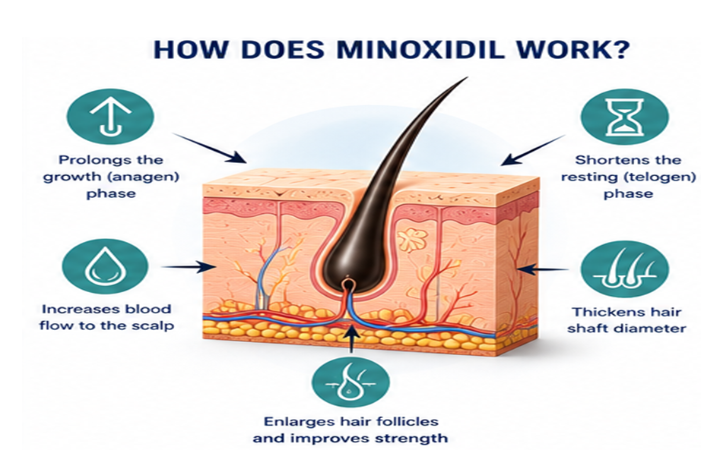
When minoxidil is converted into its active form, minoxidil sulfate, it opens ATP-sensitive potassium channels, improving blood flow around the hair follicle and stimulating dermal papilla cells.
How minoxidil works on the hair follicle.
This may help to:
Prolong the anagen (growing) phase of the hair
Shorten the resting phase
Reduce hair shedding
Help and support weakened hair follicles to grow thicker hairs
Minoxidil does not create new hair follicles. It helps existing follicles grow more effectively.
How to Choose the Right Minoxidil
The decision can be simplified into five steps:
Confirm the cause of your hair loss
Choose the appropriate strength
Choose the right base or vehicle of the minoxidil
Decide whether additional ingredients are needed
Choose between topical and/or oral treatment
Step 1: Confirm the Cause of Hair Loss
Minoxidil is most effective for pattern hair loss, but not all shedding is caused by androgenetic alopecia.
Other causes include:
Telogen effluvium
Iron and/or vitamin D deficiency
Thyroid disease
Postpartum hair loss
Rapid weight loss
Alopecia areata
Scalp dermatitis
Traction alopecia
Scarring alopecia
Medication-related hair loss
Some conditions may benefit from minoxidil, while others require the underlying cause to be treated first.
A proper hair-loss assessment may include:
Medical and family history
Scalp examination
Hair-pull test
Trichoscopy or scalp dermoscopy
Blood tests when indicated
The correct diagnosis is usually more important than the brand of minoxidil you choose.
Step 2: Choose the Right Minoxidil Strength
Topical minoxidil is usually available in 2%, 5% and 7% strength concentrations.
Feature
Minoxidil 2%
Minoxidil 5%
Minoxidil 7%
Potential hair-growth effect
Effective, but may provide less stimulation than 5%
Often more effective than 2%, particularly in male pattern hair loss
Not proven to be consistently more effective than 5%
Scalp irritation risk
Lower, although the vehicle can still irritate
Moderate; depends partly on the formulation base
Potentially higher due to increased concentration
Unwanted facial or body hair
Less likely
More likely than with 2%
May be more likely because of greater exposure
Best suited for
Patients requiring a lower-strength starting option
Standard first-line topical treatment for many patients
Carefully selected patients under medical supervision
Which strength should you choose?
2% minoxidil: Consider when a lower concentration is preferred or 5% is poorly tolerated.
5% minoxidil: The most evidence-supported standard strength for many patients with androgenetic alopecia.
7% minoxidil: May be considered for selected patients after reviewing diagnosis, response, adherence and side effects.
Clinical note: Before increasing from 5% to 7%, check whether poor results are caused by an incorrect diagnosis, inconsistent application, an unsuitable vehicle, active scalp disease or advanced follicular miniaturisation. A stronger concentration may increase irritation without necessarily producing better hair growth.
Step 3: Choosing the Right Base for Your Minoxidil
The base, also known as the vehicle, is the formulation that dissolves and delivers minoxidil onto the scalp. Although minoxidil is the active ingredient, the vehicle can influence how comfortable, practical and effective the treatment is for each patient.
The vehicle may affect:
Drug solubility: how well minoxidil remains dissolved in the formulation
Scalp delivery and absorption: how effectively the medication reaches the scalp and hair follicles
Risk of irritation: including scalp dryness, itching, redness or flaking
Texture and drying time: whether the product feels sticky, greasy or lightweight
Ease of application: especially for patients with long or thick hair
Long-term treatment adherence: patients are more likely to use a product consistently if it feels comfortable and suits their routine
The main minoxidil vehicles include conventional alcohol-based solutions, foam formulations and newer specialised vehicles such as TrichoSol®-based solutions. Each option has different advantages and limitations, so the most suitable formulation depends on the patient’s scalp sensitivity, hair type, lifestyle and treatment needs.
Feature
Alcohol-Based Solution
Foam
TrichoSol®-Based Solution
Base formulation
Usually contains alcohol and propylene glycol
Usually propylene glycol-free but may still contain alcohol
Commonly formulated without alcohol or propylene glycol
Advantages
Widely available; supported by extensive clinical use
Less sticky, often better tolerated by patients sensitive to propylene glycol
May be gentler on dry or sensitive scalps, less irritating to the scalp
Disadvantages
May cause dryness, itching, flaking or scalp irritation; may leave a sticky residue
May still cause dryness or irritation; can melt in warm hands and may be difficult to apply through long or thick hair
Limited direct clinical evidence compared with standard liquid or foam
Sensitive-scalp suitability
Variable, especially when alcohol or propylene glycol causes irritation
Often better tolerated, particularly in patients sensitive to propylene glycol
May be considered for patients sensitive to alcohol or propylene glycol
Best suited for
Patients who tolerate conventional minoxidil and those starting treatment
Patients who prefer a less sticky formulation or cannot tolerate propylene glycol
Patients requiring a personalised formulation or a potentially gentler scalp-delivery base
The best base is the one that delivers the medication effectively and is comfortable enough for consistent long-term use.
Step 4: Decide Whether Additional Ingredients Are Needed
As medicine progresses, minoxidil is sometimes combined with other ingredients as well. But more ingredients do not automatically produce better results. Each ingredient should have a clear purpose.
Minoxidil Alone
Minoxidil alone is suitable for many patients with early or uncomplicated pattern hair loss.
It may be appropriate for:
First-time users
Mild hair thinning
Patients who tolerate topical treatment well
Minoxidil Plus Topical Finasteride
Finasteride blocks the 5-alpha-reductase enzyme, which converts testosterone into dihydrotestosterone, or DHT.
In genetically susceptible patients, DHT causes progressive shrinking, or miniaturisation, of the hair follicles. This is a major cause of androgenetic alopecia.
Combining topical minoxidil with topical finasteride targets two parts of the condition:
Minoxidil: stimulates and supports hair growth
Finasteride: reduces the DHT signal that causes follicle miniaturisation
This option may be considered for selected men with progressive male pattern hair loss or an inadequate response to minoxidil alone.
Topical finasteride can still be absorbed systemically, although much less than oral finasteride. It should be prescribed after discussing potential sexual, hormonal and reproductive risks with your doctor.
Minoxidil Plus Vitamin D
Vitamin D plays a role in normal hair-follicle biology, and deficiency may be associated with several forms of hair loss.
However, evidence that adding vitamin D directly into a minoxidil spray improves results is limited.
It is important to distinguish between:
Correcting a confirmed vitamin D deficiency
Taking oral vitamin D when medically indicated
Adding vitamin D to a topical minoxidil formulation
Correcting a true deficiency is more important than adding vitamin D to a spray without a clear indication.
Therefore, not everyone needs a combination formula. Adding more ingredients does not necessarily produce better hair growth. Each ingredient should have a clear clinical purpose based on the type and cause of hair loss.
Step 5: Topical or Oral Minoxidil?
Minoxidil is available as a topical treatment (liquid, foam or spray) or as a tablet. Neither option is suitable for everyone. The choice depends on your hair-loss pattern, scalp sensitivity, lifestyle and medical history.
Topical Minoxidil
Advantages
Established treatment for pattern hair loss
Applied directly to the scalp
Available in different strengths and bases
Lower systemic exposure than oral treatment
Limitations
Requires regular application
May irritate the scalp
Can affect hairstyling
May transfer onto the face or pillow
Oral Minoxidil
Low-dose oral minoxidil may be prescribed for selected patients who cannot tolerate or consistently use topical treatment.
It may be considered when:
Topical minoxidil causes irritation
Topical treatment is difficult to use regularly
Topical minoxidil has not worked well enough
A doctor decides it is suitable
Potential advantages
Convenient daily dosing
Avoids topical irritation
Does not interfere with hairstyling
May be useful for diffuse thinning
Possible side effects
Increased facial or body hair
Ankle swelling
Dizziness
Headache
Palpitations
Changes in blood pressure
Oral minoxidil for hair loss is an off-label prescription treatment and requires proper medical assessment, particularly in patients with cardiovascular disease, low blood pressure, kidney disease, fluid retention, pregnancy or breastfeeding.
Oral minoxidil is not automatically more effective than topical minoxidil. Its main advantages are convenience and improved adherence in selected patients.
Which Minoxidil May Suit You?
Main concern
Suggested options
Starting treatment for pattern hair loss
Standard topical minoxidil
Sensitive scalp
Foam or TrichoSol base
Sticky liquid formulation
Foam or TrichoSol base
Custom strength or combination
Compounded minoxidil
Progressive male pattern hair loss
Minoxidil plus a DHT-targeting treatment
Difficulty using topical treatment
Low-dose oral minoxidil assessment
Confirmed vitamin D deficiency
Correct the deficiency alongside hair-loss treatment
Blood tests are not automatically required for every patient.Your doctor will decide based on your medical history, examination, medications and possible risk factors.
Your doctor may recommend checking your blood pressure and pulse, especially when treatment begins or the dose changes. Monitoring should be personalised according to your health and symptoms.
It may cause rapid weight gain if fluid retention develops.Unexplained weight gain together with swelling or breathlessness should be assessed promptly.
Oral minoxidil is available at LiV Clinic after Doctor assessment and prescription because it requires proper patient selection, dosing and monitoring rather than simply purchasing the tablet online.
About Author
Dr Awang Alyster is a Malaysian medical doctor with a clinical focus on skin health, hair loss and medical aesthetics. Based in Kuala Lumpur, he provides personalised treatment plans for concerns such as acne, acne scars, pigmentation, enlarged pores, hair thinning and signs of skin ageing.
His areas of interest include hair-loss treatments, laser procedures, skin rejuvenation, injectables and evidence-based skincare. Through patient education and digital content, Dr Awang Alyster aims to simplify complex medical information and help patients make safer, more informed decisions about their skin and hair.